
Flushable Packaging Substrates Market Size, Share & Forecast 2036
The Breakdown
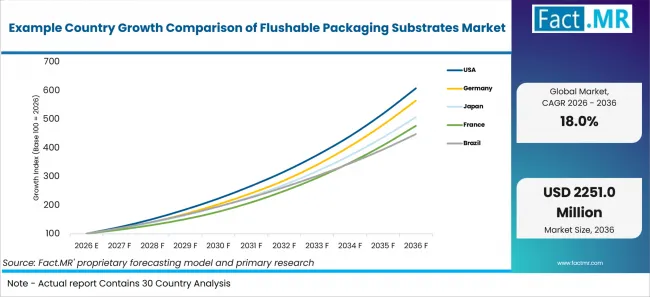
Leading global markets for flushable packaging substrates are undergoing rapid, uneven transformation—as evidenced by a 3.6 percentage point spread in forecasted growth rates between the USA and Brazil. While all regions display robust CAGRs, distinct national factors—ranging from regulatory mandates in Europe to channel structure in North America—are setting divergent entry conditions and growth accelerators. The result is a competitive landscape highly sensitive to localized market dynamics, where convergence on sustainability benchmarks intersects with the structural realities of disposal rules, converter documentation, and channel concentration. For specialty chemical and polymer leaders, navigating this complex, channel-led, and compliance-driven space requires insight beyond aggregate growth numbers.
Analyst View
Growth in flushable packaging substrates is no longer simply a matter of technological advancement—it is being reframed by the interplay of end-market demands and the operating parameters imposed by retail concentration, regulatory regimes, packaging waste targets, and the scale of retail and foodservice channels. In the US, expansive retail and foodservice channels drive accelerated trial cycles, making product adoption contingent upon barrier and disposal evidence at scale. By contrast, Germany’s pathway depends on demonstrable compliance with rigorous EU waste reduction directives and robust recycler documentation, raising the bar on product qualification but rewarding those who meet expectations.
Japanese market momentum ties directly to convenience-driven consumer segments and the country’s imperative to slash food waste—factors that favor substrates with precise moisture management and clear disposal signaling. In France, the dominance of concentrated food retail facilitates standardization, smoothing brand and converter collaboration for packaging trials. Meanwhile, Brazil’s trajectory is heavily informed by its emerging reverse logistics standards and evolving foodservice landscapes, placing a premium on documented recovery and the practicalities of regional launch strategies.
For executive decision-makers, this diversity means opportunity and complexity move in tandem. Leaders must calibrate investment strategy and partnership selection to not only match growth rates, but to anticipate approval mechanisms, pilot access, and the verification protocols embedded within each region’s value chain. Capitalizing on demand is inseparable from mastering the local market’s proof requirements, channel reach, and regulatory expectations.
Navigating the Signals
For specialty chemical and polymer executives, tomorrow’s winners will be defined by their ability to pre-empt and address not just demand, but the evidence burdens set by regulatory actors and key channel partners. Adoption curves will hinge on how quickly products can be trialed across large chains (as in the US), how thoroughly they align to circularity frameworks (as in Germany or France), and if they can provide not only performance, but documented recovery (key in Brazil and Japan).
Leadership teams should rigorously interrogate: Do our offerings have the required pilot access, compliance documentation, and demonstrated end-of-life outcomes to satisfy regional gatekeepers? Can we accelerate approval cycles in retail and foodservice environments? Are we positioned to deliver compelling evidence to both converters and regulators? With market receptivity invariably tethered to both operational capacity and ecosystem alignment, strategic foresight—and rapid proof—will dictate conversion and share gain.
What’s Next?
Breakthrough Marketing Technology specializes in guiding specialty chemical and polymer leaders through markets marked by evolving standards and shifting evidence requirements. We help organizations:
- Map readiness gaps between solution characteristics and localized adoption benchmarks.
- Prioritize partnerships across the retail and converter landscape to deepen channel penetration.
- Accelerate the path from pilot to scale by aligning technical claims with channel and regulatory documentation demands.
- Quantify and contextualize risk exposure against current and emerging standards.
Effective market engagement demands a structured approach to internal planning and external messaging. Leadership must drive not only innovation, but market-validated action.