
Operationalizing Pricing

Identify the optimum price for your products today.
Manage pricing policy for the long-term health of your business.

Seeking the Optimum Price

optimum-pricingThe expected goal of pricing policy is to maximize long-term earnings. While this is a simple concept, it is a difficult problem complicated by uncertainties, competitors, multiple products, and segments. The core issue, however, is always customer demand, or how your products or services will be purchased compared to a set of competing alternatives at various prices. The measured customer demand should be the critical driving factor for any pragmatic approach to setting price.

From a practical perspective, the starting point for pricing should be the optimum price, the price that maximizes the short-term earnings, assuming that competitors’ prices remain constant. With knowledge of the market price sensitivity and the marginal costs, potential earnings are computed. As shown in the graph below, the blue line is the expected share at a defined price assuming that the other prices remain constant. The green line represents the earnings as a percent of the maximum earnings over the same price range. The maximum point is the optimum price. Having both the share and earnings allows the business team to estimate the cost in earnings of increasing share.
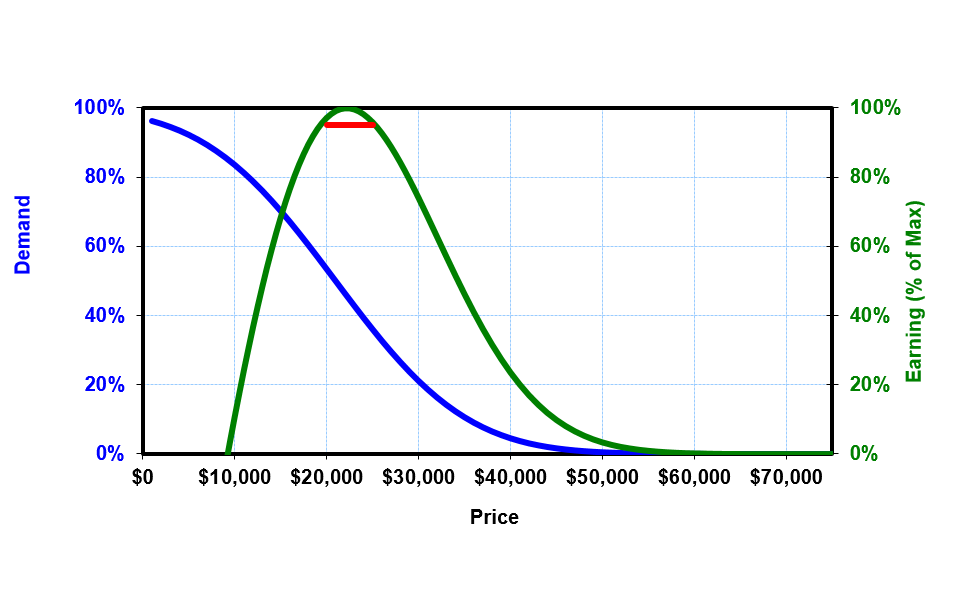

Optimum Product Pricing

Define and Implement the Optimum Price

The Steps to Optimum Pricing

1. Identify the structure of the business.

This involves specifying the competitive set, the relative manufacturing and marketing costs, relevant marketing segments, and the key value elements. The business will need to define product life cycle stage; value structure (brand and performance); and competitive brand positioning.

2. Design, test, and field the appropriate market research.

This should be done by independent marketing research firms. Using the sales force or an internal resource for these studies increases the risk of bias that could adversely impact results.

3. Analyze the data and build pricing support tools.

For the pricing process heuristic, tools and models are developed that allow for the identification of optimum pricing. Dynamic value maps are also developed to help define alternative strategic pricing positions. Typically this analysis goes well beyond the pricing issues to include perceptual, importance and competitive quadrant maps as well as a range of other marketing and quality analyses.

4. Engage the team in workshops to use the tools to set the pricing policy.

It is critical that not only are the policies agreed upon, but that the organization, and in particular the sales forces, supports it. Too many policies fail for lack of support. A major purpose of the analytical approach is to build consensus within the organization. That is, the analytical structure provides a rational approach where opinions are tested against market measurements.

Additional Benefits of Pricing Optimization

Breakthrough Marketing Technology is a strategy-focused business and marketing consultancy. We provide design guidance, research, and implementation support to companies engaging in pricing strategy and implementation. We use data-driven processes and information technology to support business decisions.

Questions like this one are what Strategalytics™ was built to answer. It combines qualitative insight with quantitative analysis to uncover growth opportunities, and determine what they’re worth before you commit.

Turn strategy into results. Stay ahead of trends and explore growth opportunities. Subscribe to LinkedIn-exclusive newsletters today!

Meet Jade™, our premier AI Assistant designed to empower your marketing strategies with unparalleled insights and automation. Discover how Jade can transform your marketing efforts and drive exceptional growth for your business.

25+
years of industry experience helping businesses transform

About the Author

Explore Other Insights

small business differentiation standout package on shelf
Small Business

Why Choose You? Standing Out in a Crowded Market

Standing out does not require a small business to be different in every way. Meaningful differentiation comes from identifying what customers value, finding where your business can deliver it better or differently, and making that advantage easy to recognize.

Read More »
Chemical Industry

Why Market Research Alone Isn’t Enough for Specialty Chemicals

Market size, growth forecasts, and industry trends provide an important foundation for strategic planning, but they do not tell the whole story. Specialty chemical companies need to connect market research with customer insight, application expertise, and competitive intelligence to determine which opportunities are worth pursuing.

Read More »
Small Business

Growing into New Markets Starts with Cultural Understanding

Growth can introduce small businesses to customers whose cultural experiences, expectations, and priorities differ from those of their established audience. Effective multicultural marketing starts with understanding those differences, then using that insight to communicate with greater relevance, build trust, and develop stronger relationships in new markets.

Read More »