
Many small business owners believe growth depends on attracting more customers. They invest in marketing campaigns, networking events, referrals, and advertising to increase visibility and generate new opportunities. Those efforts are important, but they represent only part of the growth equation.
Long-term growth depends not only on bringing customers through the door, but also on what happens after they arrive. Every interaction influences whether customers move forward, return, or recommend your business. Customer journey mapping helps small businesses understand those interactions, identify opportunities to reduce friction, and create experiences that support sustainable growth.
Small businesses are uniquely positioned to benefit from this approach. With closer customer relationships and the flexibility to adapt quickly, they can often improve the customer experience faster than larger organizations. A customer journey map helps leaders recognize where those improvements will have the greatest impact.
Growth Happens Between the Touchpoints
Your customers don’t experience your business the way you do. They don’t see departments, workflows, or organizational charts. They experience a series of connected moments that begin with their first impression and continue long after a purchase is complete. To them, every interaction is part of a single journey.
A delayed email response, a confusing proposal, an unanswered question, or a thoughtful follow-up may seem like isolated events inside your business. But from the customer’s perspective, they tell one continuous story. Each interaction either reinforces confidence or introduces uncertainty, shaping whether customers continue the relationship or begin looking elsewhere.
This is why customer journey mapping is such a valuable growth tool. It brings those individual touchpoints together into one complete picture, helping leaders understand the experience from the customer’s perspective instead of their own. Rather than asking why sales have slowed or why referrals have declined, businesses can identify where customers encounter friction and take practical steps to improve the journey before small frustrations become larger problems.
Seeing Your Business Through Your Customer's Eyes
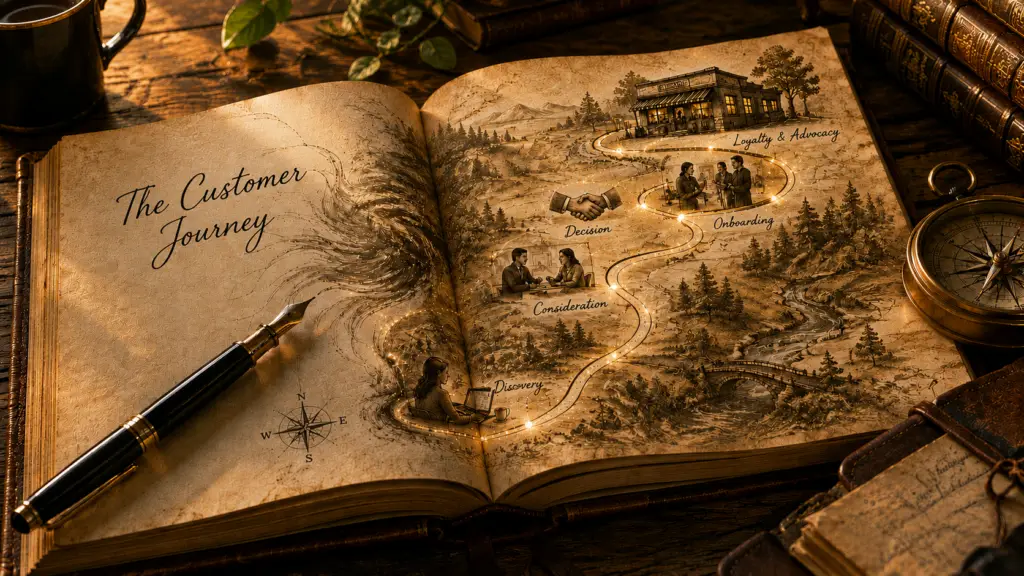
A customer journey map follows the customer’s experience from first awareness through long-term advocacy. Each stage presents opportunities to strengthen relationships—or to unintentionally weaken them. Understanding these stages helps leaders recognize where small improvements can have an outsized impact.
The customer journey begins long before someone contacts your business. Prospective customers may discover you through a search engine, a referral, social media, a networking event, or a recommendation from a colleague. At this stage, they are trying to determine whether your business is worth learning more about. They are asking questions such as:
- Can this business solve my problem?
- Do they understand organizations like mine?
- Can I trust what they're telling me?
For small businesses, customers’ first impressions of them carry significant weight. A clear website, a compelling value proposition, consistent branding, and positive customer reviews all help reduce uncertainty. If customers struggle to understand what you offer or why they should choose you, many will move on before you’ve had the opportunity to start a conversation.
Once customers believe your business may be able to help them, they begin comparing their options. They read reviews, visit your website, compare pricing, request proposals, and ask trusted colleagues for recommendations. Every interaction either increases their confidence or introduces additional uncertainty.
This stage is often where trust begins to take shape. Prompt responses, transparent communication, and a willingness to answer questions demonstrate professionalism and reliability. Small businesses sometimes assume they are competing primarily on price, when in reality they are often competing on confidence. Customers are looking for reassurance that your business understands their challenges and will deliver on its promises.
Purchasing decisions are rarely based on features or pricing alone. Customers are also evaluating risk. They want confidence that expectations are clear, communication will remain consistent, and the experience will match the promises made throughout the buying process.
Complicated proposals, unclear pricing, delayed responses, or unanswered questions can create unnecessary friction at precisely the moment customers need reassurance. Making it easy to do business with your organization often has a greater impact than adding another feature or offering another discount.
For many small businesses, the customer relationship begins in earnest after the purchase. From the first onboarding meeting or project kickoff, customers begin evaluating whether the experience matches the promises made during the buying process. Every interaction either reinforces the trust established during the buying process or begins to erode it.
Clear expectations, proactive communication, thoughtful follow-up, and responsive service demonstrate that your commitment extends beyond closing the sale. Small businesses that consistently deliver a positive experience strengthen customer relationships and create the foundation for long-term loyalty.
The customer journey doesn’t end when a project is complete or a product is delivered. The strongest businesses continue nurturing relationships through follow-up conversations, ongoing support, and meaningful customer engagement. These moments encourage repeat business while demonstrating that customers remain valued long after the transaction.
Over time, satisfied customers become advocates. They recommend your business to colleagues, leave positive reviews, and share their experiences with others. Those recommendations become one of the most effective and cost-efficient drivers of sustainable growth because they are rooted in trust rather than marketing. A thoughtful customer journey doesn’t simply create customers who are satisfied. It creates customers who confidently tell your story.
Mapping the Journey Is Only the Beginning
Customer journey mapping doesn’t improve customer experiences on its own. Its real value lies in the conversations it creates and the decisions it informs. By viewing the business through the customer’s perspective, leaders begin identifying opportunities to remove friction, strengthen trust, and improve the experience at every stage of the journey.
Many of those improvements require far less time and investment than business owners expect. Simplifying a proposal, responding more quickly to inquiries, providing proactive updates, clarifying next steps, or checking in after a project is complete may seem like small changes. Together, they create an experience that customers notice, remember, and are more likely to recommend.
This is where small businesses often have a significant advantage. Unlike larger organizations, small businesses can adapt quickly, encourage employees to share customer observations, and implement improvements without navigating layers of bureaucracy. When leaders create a culture that values listening, collaboration, and continuous improvement, customer journey mapping becomes more than a planning exercise. It becomes a practical tool for strengthening relationships and supporting sustainable growth.
The most successful small businesses understand that growth isn’t about solely by attracting new customers. It’s about making it easier for customers to move confidently from first impression to long-term loyalty. Customer journey mapping helps illuminate that path, but it is thoughtful leadership and a commitment to continuous improvement that keep customers moving forward.